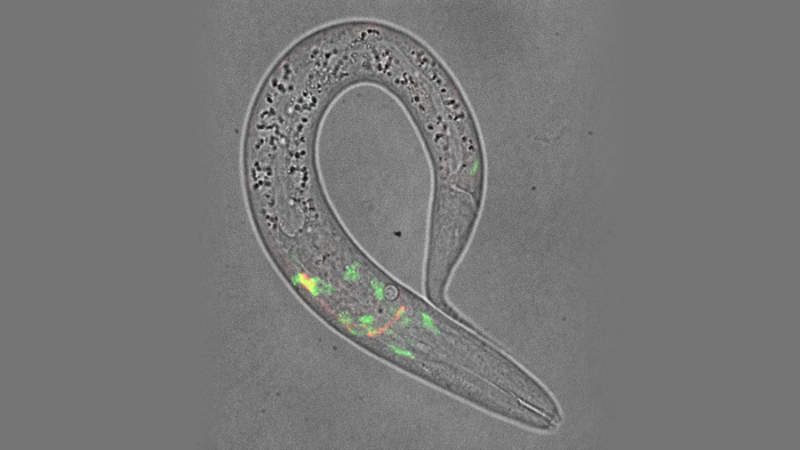
Somatostatin has long been known as a major regulator of health, memory, and lifespan, but exactly how a single molecule exerts such broad control over our health has remained a mystery. By studying roundworms, a research team led by Prof. Henrik Bringmann at the Biotechnology Center (BIOTEC) of TUD Dresden University of Technology has now discovered the missing link: sleep. They found that somatostatin does not control all these functions directly. Instead, it regulates sleep, which in turn controls health, memory, and lifespan. Published in the journal Science Advances, the findings identify sleep as the central hub through which somatostatin signaling regulates numerous physiological processes.
For over half a century, somatostatin has been known as one of the body’s most important “system managers”. It is a hormone found in nearly all animals, including humans, where it acts as a universal “stop” signal to keep growth and metabolism in check. However, scientists have long struggled to explain a biological paradox: how can a single molecule be a “jack-of-all-trades” and coordinate such a massive range of tasks, from sharpening our memory to managing how we store fat?
To explain this, scientists at the BIOTEC, turned to a simple yet powerful model: the roundworm Caenorhabditis elegans. “C. elegans are small, genetically tractable animals that share conserved physiological processes with humans, making them a valuable model for studying fundamental biological phenomena, including sleep,” says Prof. Bringmann, research group leader at the BIOTEC.
The Sleep Connection
The breakthrough came when the team identified a somatostatin receptor in the worm’s brain. “Hormones generally work like keys that fit into certain locks on cells. This interaction then activates different functions within the cell. We found that the ‘lock’ for the somatostatin-like molecule in worms is located directly on the sleep-active neuron. This is a single cell that controls sleep in the worm,” explains Dr. Byoungjun Park, who carried out the study.
To confirm this link, the researchers conducted a series of metabolic and behavioral tests. By genetically removing the receptor – the molecular lock that the hormone fits into – they were able to observe what happens when the hormone can no longer communicate with the sleep neuron.
A Strategic Control Center
“We were able to show that the control of the sleep neuron by the somatostatin-like molecule is indeed crucial for regulating metabolism, memory, and lifespan,” says Prof. Bringmann. “Our study shows that somatostatin does not need to communicate with every cell in the body to promote these different functions. Instead, it targets a strategic control center: the sleep neuron,” says Prof. Bringmann.
From 302 Neurons to Billions
Focusing on the roundworm C. elegans allowed the team to strip away the complexity of higher organisms to find fundamental connections. While humans are far more complex, the core biological principles often remain identical.
“Humans have billions of neurons and multiple centers controlling sleep, whereas the roundworm has exactly 302 neurons and one sleep-active neuron," Prof. Bringmann notes. "This is precisely why basic research with roundworms is so important. It allows us to untangle complex interactions and reveal principal mechanisms that govern life and health.”
Original Publication
Byoungjun Park, Lama Mohsen, Inka Busack, Laura Uhlig, Lorenzo Rossi, Gill Pollmeier, Ellen Geens, Majdulin Nabil Istiban, Sajal Mandal, Reshma Dominic Savio, Isabel Beets, Attila Stetak, and Henrik Bringmann
C. elegans somatostatin/allatostatin C signaling regulates sleep, metabolism, survival, and memory via a sleep-active neuron
Science Advances (April 2026) | DOI: 10.1126/sciadv.adv8387
Source: CMCB News