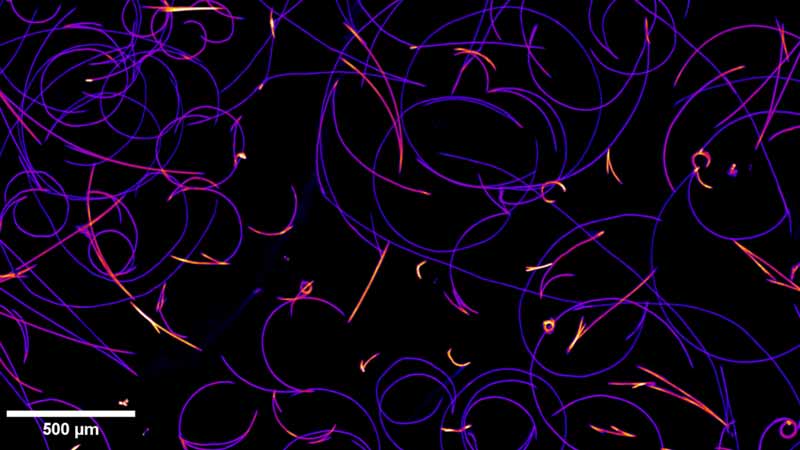
Mobility is essential for living organisms, enabling them to respond to their environment and navigate towards favorable environmental conditions. Yet how diatoms, single-celled algae encased in rigid, glass-like shells, manage to move and turn rapidly without shape changes or external appendages has long remained a mystery. An interdisciplinary team led by Prof. Stefan Diez and Dr. Nicole Poulsen at the B CUBE – Center for Molecular Bioengineering has now uncovered a surprisingly simple mechanism: diatoms steer by shifting where their cell wall contacts the surface beneath them.
Diatoms are among the most important microorganisms on Earth, playing a key role in global oxygen production and carbon dioxide uptake. These cells are enclosed in rigid silica shells – essentially microscopic “glass-houses” – which makes their agility all the more puzzling.
“Diatoms can move with very different trajectories – sometimes straight, sometimes in tight circles,” says Dr. Nicole Poulsen, senior scientist at B CUBE who co-led the study. “But their cell walls are stiff and cannot bend. Until now, it was unclear how they can change direction so quickly without flexible structures or external appendages such as cilia.”
To address this long-standing question, the scientists at the B CUBE combined their expertise in biophysics of cell motility and diatom cell biology. The team used high-precision tracking of individual cells, electron microscopy, and collaborated with the group of Prof. Ulrich Schwarz at the Heidelberg University for mathematical modeling.
The researchers recorded hours of high-resolution footage of diatoms moving across surfaces. “We then tracked the motion of hundreds of individual cells and analyzed the shape of their paths. We were surprised to find, that their movement could change abruptly – from almost straight lines to tight circular turns – very counterintuitive for a cell encased in a rigid glass wall,” says Dr. Stefan Golfier, author of the study.
Closer inspection with the use of optical interference-reflection microscopy and electron microscopy revealed the underlying mechanism: diatom cell walls contain curved slits, so-called raphe branches, which transmit the forces required for gliding. The team could show, that by tilting their rigid shells to lift one side off the surface, diatoms can engage different parts of their raphe branches. The local curvature of the engaged segment then determines the curvature of the cell's path.
“Whenever a diatom lifts off one side, the cell starts to turn sharply. When both sides are in contact with the surface, the cell moves in a straight line,” says Golfier.
Building on these observations, the team of theoretical physicists in Heidelberg developed a mathematical model of the gliding mechanism, which connects the microscopic geometry of the raphes to the macroscopic trajectories observed with the optical microscopes. This model provides strong evidence that diatoms can dynamically tune the distribution of forces on short raphe segments to achieve steering.
“We uncovered a simple physical principle that allows a rigid single cell to navigate dynamically,” says Prof. Stefan Diez. “These insights from nature could inspire the design of robust machines at the smallest scales and resolve a decades-old mystery: how motile diatoms are able to move the way they do.”
Funding
The work was supported by a Nucleation Grant from the Cluster of Excellence Physics of Life (PoL). PoL Nucleation Grants support the initiation of new innovative project ideas and collaborations between PoL member groups.
Original Publication
Stefan Golfier, Veikko F. Geyer, Leon Lettermann, Ulrich S. Schwarz, Nicole Poulsen, Stefan Diez: Dynamic switching of cell-substrate contact sites allows gliding diatoms to modulate the curvature of their paths. PNAS (April 2026)
doi: 10.1073/pnas.2506122123
Source: B CUBE News