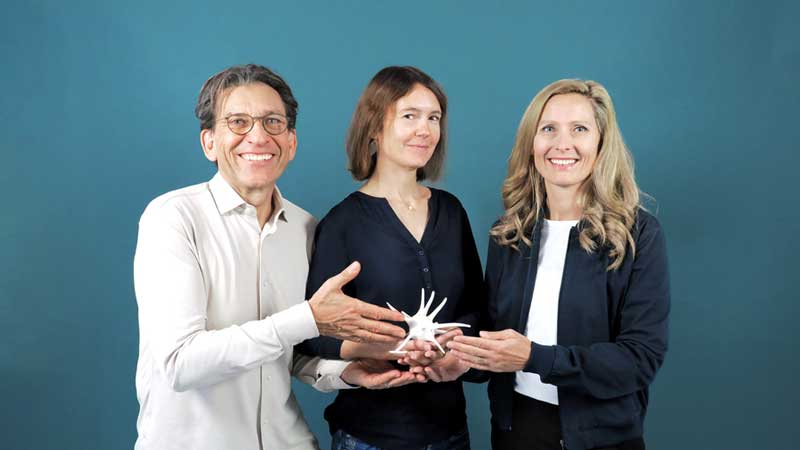
The European Innovation Council (EIC) is funding the StemPhage project with €2.5 million. The project brings together the immunological research of Prof. Michael Sieweke and the cell production expertise of Dr. Anke Fuchs at the Center for Regenerative Therapies Dresden (CRTD) at TU Dresden to develop a novel immune cell therapy for cancer and prepare it for clinical application. StemPhage is one of only three projects funded by the EIC in Germany and among 40 selected from 611 applications across Europe.
Immune Cells as Cancer Killers
The planned start-up EliaCell, led by Prof. Michael Sieweke, Dr. Anke Fuchs, and Dr. Angela Jacobi, is developing a new form of immunotherapy. The approach is based on macrophages – immune cells that normally recognize and destroy pathogens in the body. The team at the CRTD has now modified these cells to attack cancer cells effectively and sustainably.
“You can think of them as genetically optimized ‘super macrophages’,” says Prof. Michael Sieweke, Alexander von Humboldt Professor at the CRTD. “Building on decades of research, we have developed macrophages that can be reproduced at large scale and are capable of sustainably combating solid tumors.”
Challenge: Solid Tumors
The treatment of solid tumors remains one of the greatest challenges in oncology. Unlike blood cancers such as leukemia and lymphoma, solid tumors form dense masses of tissue and account for about 90% of all cancers. Immune cell therapies that are effective against blood cancer have so far mostly failed to penetrate solid tumor tissue effectively.
“Macrophages, on the other hand, are very good at entering tumor tissue. However, until now it has not been possible to produce conventional macrophages in large quantities, and they quickly lose their activity in tumors. Through genetic activation, we have now been able to strengthen macrophages so that they divide more frequently, persist in the tumor over the long term, and can continuously attack cancer cells,” explains Prof. Sieweke. “Our goal is to open up new treatment options for patients with solid tumors that have been difficult or impossible to treat until now.”
Affordable Cutting-Edge Medicine
High costs have so far limited the widespread use of cell therapies in healthcare systems. Until now, cell therapy has relied on complicated logistics and lengthy processes to prepare patients’ own cells. A new approach aims to change this. Thanks to their special ability to multiply, EliaCell macrophages can be produced in pharmaceutical-grade quality and in large quantities for storage and then retrieved as needed. Therapies that have previously relied on highly specialized laboratories and a few select clinics could therefore become more widely available in the future.
“Our production process has already been optimized to be compatible with established industry standards for cell-based therapies,” explains Dr. Anke Fuchs, research group leader for novel therapies at the CRTD and scientific head of the GMP clean room for clinical cell production.
Basic Research Drives Innovation
The project exemplifies how excellent basic research can enable clinical progress and economic value creation. StemPhage builds on previous European Research Council (ERC) Advanced Grant and Proof-of-Concept projects carried out by Prof. Michael Sieweke. With the new EIC Transition funding, the team will now develop a clinical-grade cell therapy and prepare for a first clinical trial.
‘The EIC funding allows us to take the crucial next step towards clinical translation,’ says Dr. Angela Jacobi, coordinator for StemPhage and the driving force behind the planned start-up.
The EliaCell team is also working closely with the Cluster for Future “Living Drugs” SaxoCell and clinical partners such as Prof. Martin Bornhäuser (Medical Clinic I) and Prof. Martin Wermke (Early Clinical Trial Unit - ECTU) at the Carl Gustav Carus University Hospital in Dresden. The clinical trial expertise and the existing infrastructure in Dresden provide excellent conditions for the successful implementation of the project. Together, the partners are pursuing the goal of establishing Saxony as a leading European innovation location for cell-based therapies.
“As a European company based in the heart of Saxony, this funding is more than just financial support for EliaCell: it confirms a technological approach that is unique in Europe and creates the conditions for developing an excellent innovation into a strong, internationally competitive company,” concludes Dr. Angela Jacobi.
About EIC Transition Funding
The European Innovation Council (EIC) strengthens Europe's technological sovereignty by supporting groundbreaking high-tech innovations on their way to market. It funds projects with the potential to shape new fields of technology and secure Europe's competitiveness in the global innovation race.
Grants of up to €2.5 million are available to validate and demonstrate technology in application-relevant environment and develop market readiness. The selected projects will have access to EIC Business Acceleration Services including coaching, mentoring, and partnering events. Projects are also eligible for the fast-track scheme to access the EIC Accelerator for supporting the commercialization and scale up phases.
About the Center for Regenerative Therapies Dresden (CRTD)
The Center for Regenerative Therapies Dresden (CRTD) of TUD Dresden University of Technology is an academic home for scientists from more than 30 nations. Their mission is to discover the principles of cell and tissue regeneration and leverage this for the recognition, treatment, and reversal of diseases. The CRTD links the bench to the clinic, scientists to clinicians to pool expertise in stem cells, developmental biology, gene-editing, and regeneration towards innovative therapies for neurodegenerative diseases such as Alzheimer's and Parkinson's disease, hematological diseases such as leukemia, metabolic diseases such as diabetes, bone and retina diseases. The CRTD was founded in 2006 as a research center of the German Research Foundation (DFG) and funded until 2018 as a DFG Research Center, as well as a Cluster of Excellence. Since 2019, the CRTD is funded by the TU Dresden and the Free State of Saxony.
The CRTD is one of three institutes of the central scientific unit Center for Molecular and Cellular Bioengineering (CMCB) of the TU Dresden.
Source: CMCB News