
Officially Certified Copies
What is this and how can I obtain them?
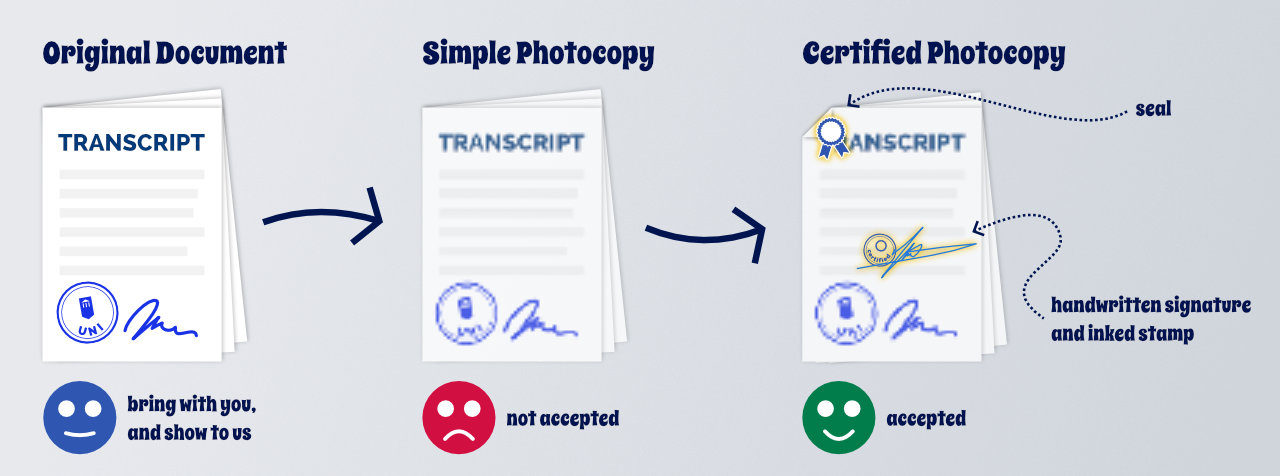
An official certification legally confirms that a copy corresponds the original. To do this, the copy and original of the document are compared with each other and the copy is confirmed by the authority to be authentic.
How and where can I obtain an officially certified copy?
Bring the original document to an authority (see below) that is legally allowed to certify copies. They will make a photocopy of it and authenticate the copy.
In Germany
Any public institution with an official seal (“Dienstsiegel”) can certify documents, for example:
- The university that issued your certificate
→ If you have graduated from TU Dresden, you can obtain certified copies of your documents within two years of graduation. - Embassy or consulate of your home country
- Notary
- Local municipal office (“Bürgeramt”) – but only if the documents are issued in German!
Universities often provide a few certified copies together with the original certificate. Additional copies may cost a small fee.
Outside Germany
The following institutions may certify documents:
- The issuing institution (e.g. university)
- German embassies or consulates
- Notary
How can I recognise an officially certified copy?
An officially certified copy is a photocopy of the original document and must include:
- an official stamp (ink), and
- a handwritten signature (ink)
Both must come from the authority that verified the document.
Digital signatures are not accepted, including digitally inserted handwritten signatures.
Certification of documents with multiple pages
If a document has several pages, it can be certified in two ways:
Collective certification
- The first page has the official stamp and signature
- All pages are connected and sealed together (e.g. with a stamp across the folded pages)
Individual certification
- Each page has its own official stamp and signature.